📋 Summary
- The TE27 Corolla Levin and Sprinter Trueno, launched in 1972, were the very first cars to carry these names – decades before the AE86 made them world-famous
- Power came from the 2T-G, a 1.6-liter twin-cam engine co-developed with Yamaha, producing around 115PS – genuinely potent for a small Japanese coupe of the era
- The names “Levin” (from an old word for lightning) and “Trueno” (Spanish for thunder) were chosen specifically for the performance versions of an otherwise ordinary economy car platform
- These cars are frequently overshadowed by the AE86 in Western enthusiast culture, but they are historically the true origin point of the Levin/Trueno performance lineage
Ask almost any car enthusiast outside Japan what a “Corolla Levin” or “Sprinter Trueno” is, and they will describe the AE86 – the lightweight, rear-wheel-drive coupe immortalized by Initial D and drift culture. What far fewer people realize is that the Levin and Trueno names are more than a decade older than the AE86, and the car that started it all, the TE27, is arguably an even purer expression of what those names were originally meant to represent.
How an Economy Car Got a Twin-Cam Heart
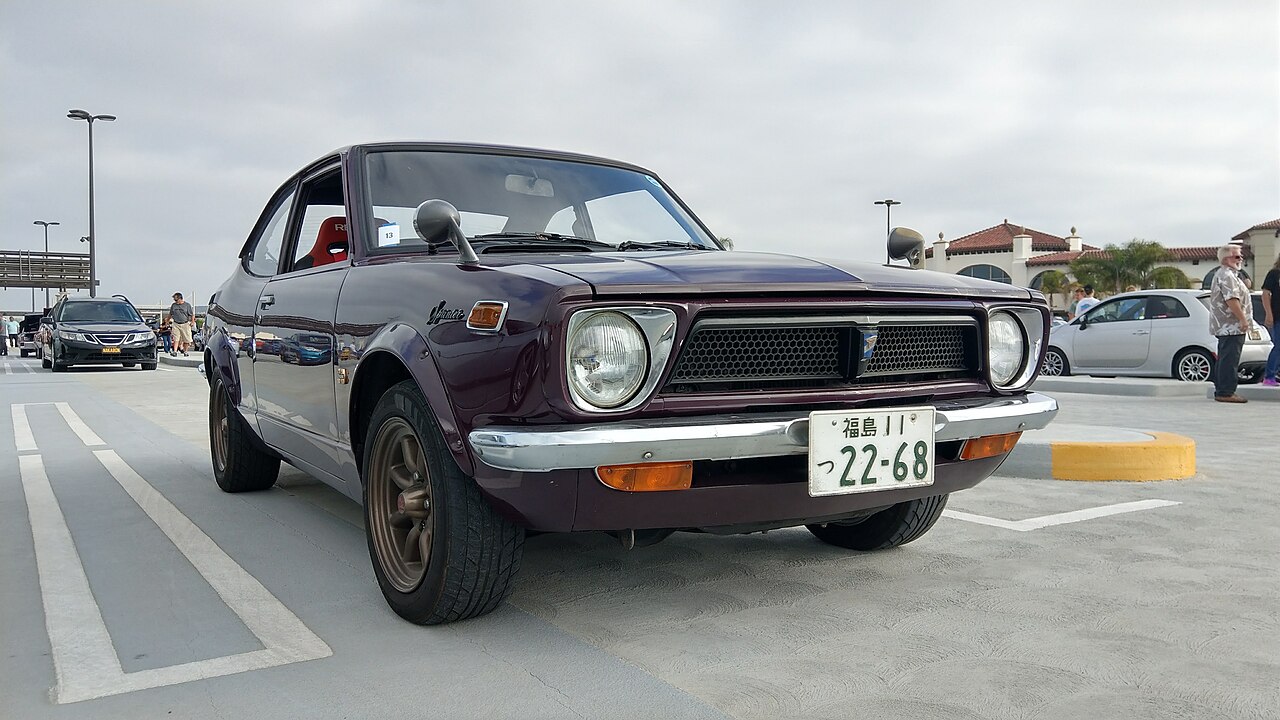
The Corolla, in its early generations, was Toyota’s mainstream economy car – reliable, affordable, and thoroughly unremarkable in performance terms. In March 1972, Toyota introduced a genuinely different variant: a lighter, more compact coupe built on the 20-series Corolla and Sprinter platform, fitted with the 2T-G engine borrowed from the Celica performance coupe. This was a deliberate move to bring genuine performance credentials to the Corolla name, and it needed a name of its own to signal that difference to buyers.
Toyota chose two separate names for what was mechanically the same car, sold through different dealership networks in Japan: “Levin,” derived from an old Middle English word related to lightning, for the Corolla version, and “Trueno,” the Spanish word for thunder, for the Sprinter version. Both names were explicitly chosen to evoke speed and power – a clear statement that these were not ordinary Corollas.
The 2T-G: A Genuinely Serious Engine for a Small Car
The heart of the TE27 was the 2T-G, a 1.6-liter inline-four with a twin-cam cylinder head co-developed with Yamaha – the same partnership that produced performance engines for other Toyota models of the era. Output is commonly cited at around 115PS (113 hp) at 6,400rpm, with peak torque of roughly 142Nm at 5,200rpm. Those are genuinely strong figures for a lightweight small coupe in the early 1970s, and they gave the TE27 performance well beyond what its humble Corolla underpinnings might suggest.
To match the more powerful engine, Toyota fitted the Levin and Trueno with a five-speed manual transmission, firmer suspension tuning, front disc brakes, larger rear drum brakes, and radial tires – a genuine performance package, not just a badge and a bigger engine dropped into an otherwise unchanged economy car.
💡 Tip: This Is the Car the AE86’s Reputation Was Built On
When the third-generation Corolla and Sprinter launched in 1974, a coupe body was not immediately available, so the Levin name was initially carried over onto the TE37 Corolla hardtop before the lineage eventually led to the AE86 in the 1980s. Understanding the TE27 gives useful context for why the AE86 carried the weight of expectation it did when it arrived: it was inheriting a name that already meant something specific to Japanese enthusiasts – a lightweight, twin-cam-powered, genuinely sporting version of an otherwise ordinary family car.
Why the TE27 Is Overlooked Outside Japan
Part of the reason the TE27 remains relatively obscure to Western enthusiasts, compared to the AE86 it eventually led to, comes down to simple exposure. The AE86 benefited enormously from pop culture, most famously Initial D, along with a rear-wheel-drive chassis layout that translated directly into drift and grip motorsport in the 1990s and 2000s, right as import car culture was exploding in the West. The TE27, by contrast, had its heyday a full generation earlier, sold in far smaller numbers outside Japan, and never had the same cultural moment abroad.
Within Japan, however, and among serious classic Toyota collectors globally, the TE27 is recognized as an important, historically significant car in its own right – not simply a footnote on the way to the AE86, but the genuine original expression of the Levin/Trueno performance concept.
What to Look For When Buying
Because the TE27 is now more than fifty years old and was never sold in huge numbers, particularly outside Japan, finding a genuine, well-preserved example requires patience and careful verification.
- Confirm the correct engine and chassis code: The 2T-G engine is central to the car’s identity and value. A TE27 with a non-original, lower-spec engine, or one that cannot be verified, is a fundamentally different and less desirable car than a genuine 2T-G example.
- Inspect thoroughly for rust: As with any Japanese unibody car of this era, corrosion in the floor pans, sills, and suspension mounting points is the single biggest structural risk. A lift inspection is strongly recommended before purchase.
- Check for aftermarket bodywork versus factory-correct panels: Given the car’s performance reputation, some surviving examples have been modified over the decades with flared fenders or other non-standard bodywork. Decide whether you are looking for factory originality or are comfortable with a modified example, and verify accordingly.
- Verify the transmission and drivetrain match factory specification: A correct five-speed manual, matched to the 2T-G engine, is part of what made the original TE27 special. Confirm the drivetrain configuration matches what the car should have from factory.
- Ask about parts availability before committing: Given the car’s age and relatively low original production numbers outside Japan, some components can be genuinely difficult to source. Understanding what is and is not available before you buy will save considerable frustration later.
⚠️ Caution: Genuine, Unmodified Examples Are Increasingly Rare
As classic JDM values have risen globally, interest in early Levin/Trueno models has grown alongside interest in the AE86, which has pushed up both prices and the incentive for sellers to present modified or incomplete cars as more original than they actually are. Because the TE27 predates widely available vehicle history databases and was built in relatively modest numbers, verifying a car’s history often relies on documentation, ownership records, and expert knowledge rather than a simple database lookup. Buyers should be especially cautious of cars with incomplete paperwork or vague answers about engine and chassis history.
A Small Coupe With Real Motorsport Ambitions
The TE27 was not built purely as a road car with a sporty badge – Toyota positioned it as a genuine competition platform from the start. Its combination of light weight, a genuinely potent twin-cam engine, and a five-speed gearbox made it a natural fit for Japanese domestic rallying and circuit racing in the 1970s, and it built a competitive reputation in period that helped establish the Levin and Trueno names as synonymous with performance rather than simply trim levels. That motorsport DNA is part of why the names carried real weight by the time they were eventually applied to the AE86 more than a decade later – Toyota was not inventing a new performance image from scratch, it was building on a foundation the TE27 had already laid.
This context also explains why serious Toyota historians and collectors treat the TE27 with a level of respect that goes beyond simple nostalgia. It represents an era when a mainstream manufacturer’s engineering and motorsport divisions worked closely together to turn an economy car platform into something genuinely competitive, using a formula – lightweight body, high-revving twin-cam engine, focused chassis tuning – that Toyota would return to again and again in the decades that followed.
Frequently Asked Questions
Q: Is the TE27 related to the AE86?
A: They share the same Levin/Trueno naming lineage and the same basic concept – a lightweight, performance-oriented coupe built on Toyota’s mainstream small-car platform – but they are different generations built more than a decade apart, with different engines, chassis codes, and mechanical layouts.
Q: What does the 2T-G engine offer over a standard Corolla engine of the era?
A: The 2T-G is a 1.6-liter twin-cam four-cylinder co-developed with Yamaha, producing roughly 115PS – substantially more power than the pushrod engines used in standard economy Corollas of the same period, and paired with a genuine performance package including a five-speed manual, firmer suspension, and front disc brakes.
Q: Why are “Levin” and “Trueno” two different names for what is mechanically the same car?
A: Toyota sold the same basic vehicle through two different dealership networks in Japan under different badges – Corolla dealers sold the Levin, while Sprinter dealers sold the Trueno. This dual-badging approach continued through later generations, including the AE86.
Q: Is the TE27 rarer than the AE86?
A: Generally, yes, particularly outside Japan. The AE86 was produced in significantly larger numbers and exported more widely, while the TE27 was a lower-volume, earlier model with a smaller international footprint, making genuine surviving examples harder to find today.
Q: What should I check first when evaluating a TE27 for purchase?
A: Confirm the engine is a genuine, correctly matched 2T-G, inspect thoroughly for rust in structural areas, and ask for documented history. Given the car’s age and value, a pre-purchase inspection by someone experienced with classic Toyota models is strongly recommended.
This article is for general informational purposes. Specifications and historical details are based on widely cited sources and may vary slightly between references. Always consult a qualified classic-car specialist before purchasing a collector vehicle.
Image credit: Toyota Sprinter Trueno (TE27) by Phil, CC BY-SA 2.0, via Wikimedia Commons
コメント