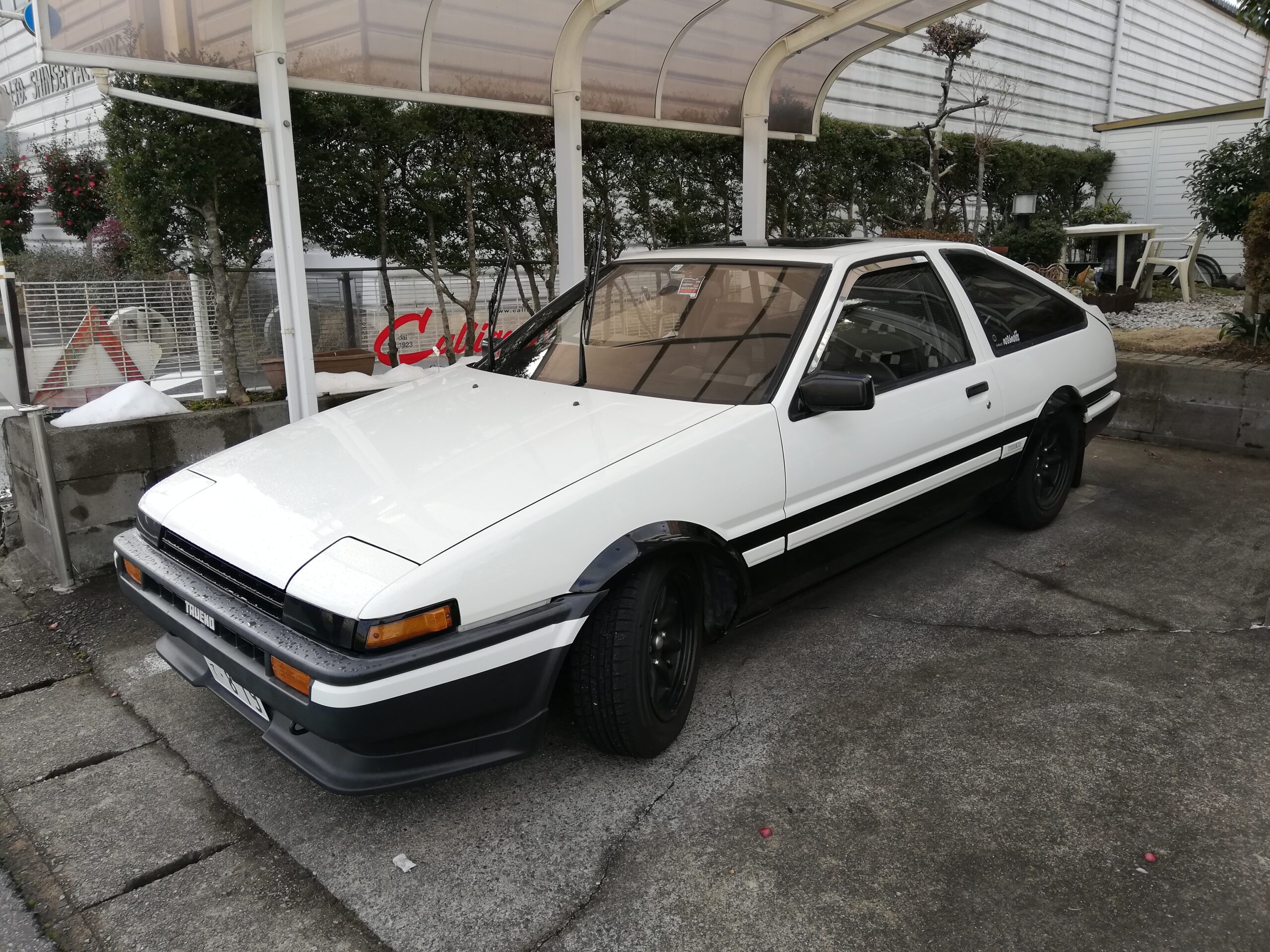
Few cars illustrate the gap between “objectively modest performance” and “cultural icon” quite like the Toyota AE86. Sold as the Corolla Levin and Sprinter Trueno from 1983 to 1987, it was a fairly ordinary compact coupe by the standards of its own era — yet thanks to a near-perfect front-engine, rear-wheel-drive layout, a revvy twin-cam engine, and a starring role in the manga and anime series “Initial D,” the “Hachi-Roku” (Japanese for “eight-six”) now commands prices that would have seemed absurd to anyone shopping for one new. This guide explains what actually makes the AE86 special, why rust is the single biggest threat to any example you’re considering, and how to avoid the identity-fraud problems that plague this specific market.
📋 What You’ll Learn in This Guide
- The difference between the Corolla Levin and Sprinter Trueno badges
- Why rust — not the engine — is the AE86’s real long-term threat
- How to verify a genuine 4A-GE engine and factory limited-slip differential
- Why “AE85 disguised as an AE86” is a real scam to watch for
- What actually drives AE86 pricing today
- Levin vs. Trueno: What’s the Difference?
- Zenki vs. Kouki: The Two Production Phases
- The 4A-GE Engine: Modest Power, Legendary Character
- Rust: The AE86’s Real Enemy
- The AE85 Problem: A Real Identity-Fraud Risk
- Suspension, Handling, and Why Enthusiasts Rate It So Highly
- Interior and Parts Availability Considerations
- What Drives AE86 Pricing Today?
- Frequently Asked Questions
- Final Thoughts
Levin vs. Trueno: What’s the Difference?
Toyota sold essentially the same car under two names distinguished mainly by their front-end styling. The Corolla Levin has fixed rectangular headlights, while the Sprinter Trueno has pop-up headlights — a styling choice that also happens to make the Trueno the more instantly recognizable of the two thanks to its starring role in Initial D, where the main character’s Trueno became one of the most famous fictional cars to come out of Japan. Mechanically the two are essentially identical, so the choice between them comes down almost entirely to styling preference and, in today’s market, to the fact that Trueno examples often command a modest premium purely because of their pop culture association.
Zenki vs. Kouki: The Two Production Phases
Toyota built the AE86 in two distinct phases: the Zenki (“early”) cars from 1983 to 1985, and the Kouki (“late”) cars from 1986 to 1987, which received a mild refresh including revised bumpers, taillights, and interior trim. Neither phase is considered mechanically superior to the other, and the choice mostly comes down to styling preference, though some collectors have specific preferences for one phase’s aesthetic over the other.
The 4A-GE Engine: Modest Power, Legendary Character
The AE86’s twin-cam 4A-GE produces roughly 130 horsepower from 1.6 liters — a figure that sounds unremarkable today but felt genuinely sharp in a lightweight compact coupe in the mid-1980s, especially given the engine’s eagerness to rev to a 7,600 rpm redline. The 4A-GE has a strong aftermarket tuning history, with common upgrade paths including individual throttle bodies, the later “20V” cylinder head (from the related 4A-GE used in other Toyota models), and supercharger or turbocharger kits for buyers chasing serious power. For a stock or lightly modified buyer, the appeal isn’t outright speed by modern standards — it’s the combination of low weight, a well-balanced chassis, and an engine that rewards being driven at high RPM.
💡 Tip
The factory Torsen-type limited-slip differential was only available on the Trueno/Levin GT-APEX trim with the five-speed manual transmission — it wasn’t standard across the whole range. If a listing claims a factory LSD, verify it directly with a simple jack-up test (spin one rear wheel and confirm the opposite wheel turns in the same direction) rather than taking the claim at face value, and ask whether documentation supports it being the original factory unit rather than an aftermarket addition.
Rust: The AE86’s Real Enemy
The 4A-GE engine, gearbox, and rear axle are all mechanically durable when properly maintained — the AE86’s real long-term vulnerability is its body, not its drivetrain. Sill panels are structural on this chassis and rust from the inside out, often invisibly until the damage is severe. Floor pan rust is a similarly serious and similarly hidden problem, since it’s concealed under the interior carpet by design. Any serious inspection needs to go beyond a visual walk-around: lift the carpet to check the floor pans directly, probe rocker panels and sills (particularly around any side skirt trim, which can hide rot underneath), and be willing to walk away from any panel that feels soft when pressed.
⚠️ Caution
Given how much AE86 prices have risen, structural rust repair on a car that initially looked cheap can easily cost more than buying a genuinely rust-free example in the first place. Budget for a rust-focused inspection by someone experienced with this specific chassis, and treat any car you can’t personally inspect closely (or have inspected by a trusted specialist) as a real risk, no matter how good the auction sheet or photos look.
The AE85 Problem: A Real Identity-Fraud Risk
Toyota also sold a visually near-identical but mechanically much more modest sibling, the AE85, which used a simpler single-cam engine (the 3A-U) rather than the twin-cam 4A-GE, and generally lacked the AE86’s sportier suspension tuning and available limited-slip differential. Because the two cars look almost the same from the outside, unscrupulous sellers occasionally present an AE85 — or an AE86 with a non-original engine swapped in — as a “genuine” AE86 to unfamiliar buyers. The most reliable quick check is the number of cam covers on the engine: the twin-cam 4A-GE has two, while the single-cam 3A-U has one. This single check is worth more than almost anything you’ll find written on an auction sheet, and it takes seconds to verify with your own eyes or your agent’s.
Suspension, Handling, and Why Enthusiasts Rate It So Highly
Part of what makes the AE86 special has nothing to do with straight-line power and everything to do with weight distribution and chassis balance. The car uses a front-engine, rear-wheel-drive layout with a live rear axle — a simpler, more old-fashioned setup than the independent rear suspension found on many contemporaries — but combined with genuinely low curb weight and a low center of gravity, it produces a chassis that communicates clearly with the driver and rewards smooth, momentum-conscious inputs. This is a large part of why the AE86 became closely associated with mountain-pass (“touge”) driving in Japan well before Initial D popularized that connection internationally; the car’s real-world driving character and its fictional reputation actually line up unusually well compared to many “legend” cars where the on-road reality doesn’t quite match the hype.
Interior and Parts Availability Considerations
As a genuinely old car now — approaching its fifth decade since the first examples left the factory — interior trim, certain rubber components, and some body panels can be harder to source in original condition than on more recently produced JDM classics. The car’s popularity has spurred a healthy reproduction parts industry for common wear items, which helps, but panel-specific trim pieces and interior plastics in good condition are not always easy to find. Factor this into your assessment of any car with visibly worn or damaged interior trim, since replacing it may take more time and cost more than you’d expect from a newer classic.
What Drives AE86 Pricing Today?
AE86 values are driven by a combination of factors that don’t always track with mechanical condition alone: body style (Trueno vs. Levin), production phase (Zenki vs. Kouki), originality of the engine and drivetrain, rust-free structural condition, and — perhaps more than with most JDM classics — general cultural desirability tied to the car’s Initial D fame. A rust-free, numbers-matching Trueno GT-APEX with a genuine factory limited-slip differential sits at the top of the market, while cars with unclear history, non-original engines, or rust repairs sell for meaningfully less. As with any JDM import, get a full landed-cost estimate covering vehicle price, agent fees, shipping, insurance, and your home country’s duties and compliance costs before setting a budget.
Frequently Asked Questions
Q: Is the AE86 actually a good car to drive, or is its reputation mostly nostalgia and fiction?
A: It’s a genuinely well-balanced, lightweight rear-wheel-drive car that rewards momentum-focused driving, even if its raw power output is modest by modern standards. The reputation isn’t purely manufactured — the fundamentals that made it popular with drivers and racers in period are real — but its current fame and pricing owe a great deal to Initial D’s cultural impact well beyond Japan.
Q: Are AE86 wagons (Sprinter/Corolla wagon variants) worth considering?
A: Wagon versions exist and share some mechanical DNA, but they are generally not the same performance-oriented cars as the Levin/Trueno coupes and don’t carry the same collector value — confirm exactly which body style and drivetrain configuration you’re looking at before assuming it’s equivalent to a coupe.
Q: How much should I budget for restoration if I find a project car?
A: This varies enormously by the extent of rust and mechanical work needed and by labor costs in your own country, so it’s not something this guide can responsibly quote a specific figure for — get a written assessment from a specialist before committing to a project car, since structural rust repair costs can escalate quickly once a shop opens things up.
Final Thoughts
The AE86’s appeal is genuine, but so is the risk in a market where hype has pushed prices well above what the car’s original, fairly modest engineering brief would ever have suggested to Toyota’s own product planners back in 1983. Confirm you’re actually looking at a twin-cam AE86 and not a re-badged AE85, check for a genuine factory limited-slip differential if that matters to you, and above all, prioritize a thorough rust inspection over cosmetic presentation. Buy carefully, and the Hachi-Roku remains one of the purest, most rewarding lightweight rear-wheel-drive experiences to come out of 1980s Japan.
コメント