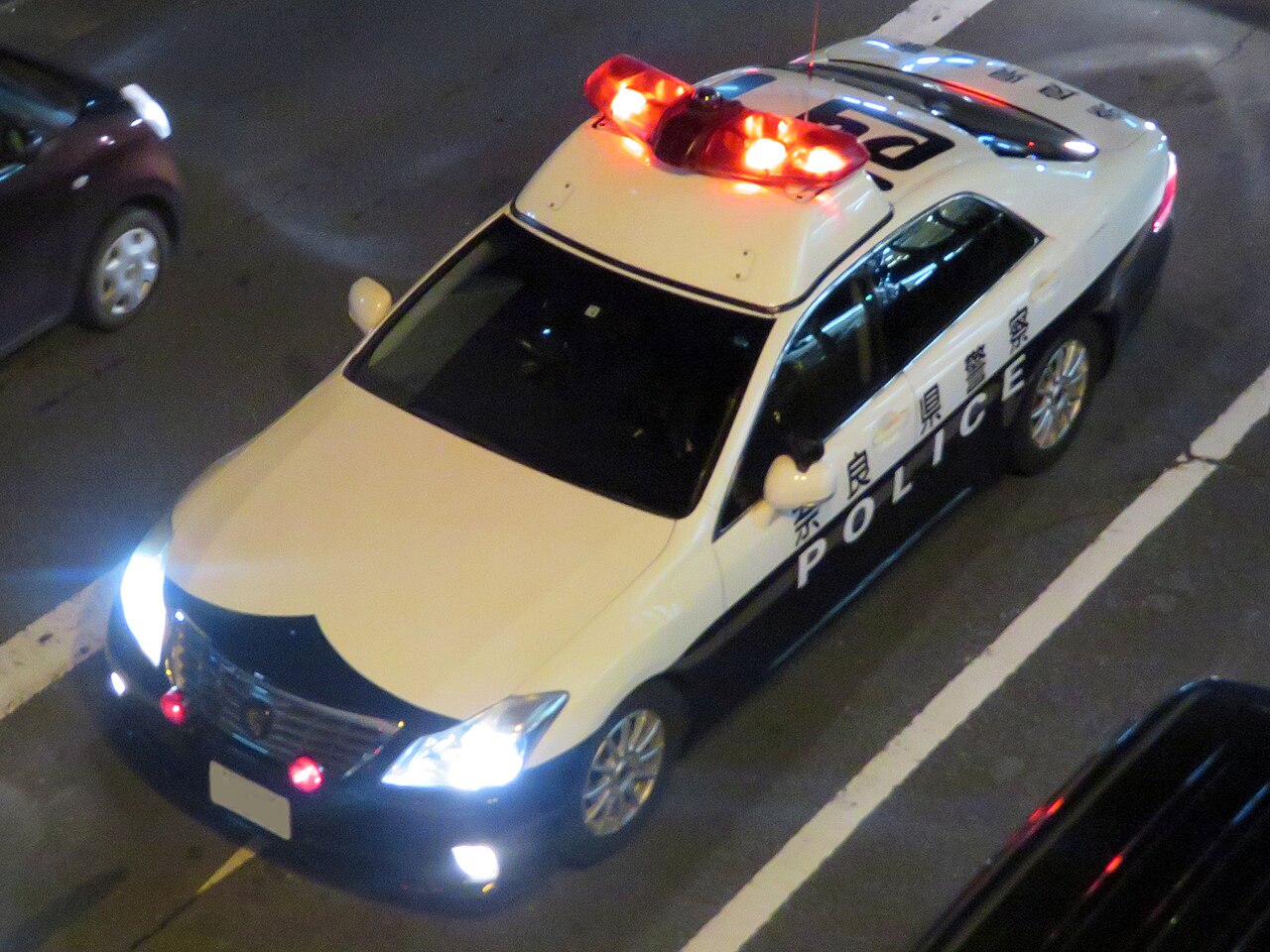
Two earlier guides in this series covered the Toyota Century and Nissan President, Japan’s dedicated chauffeur-driven flagship sedans built for the country’s most senior figures. There’s a third, considerably more visible Toyota Crown role that touches nearly every Japanese driver’s daily life directly: as the backbone of Japan’s police patrol car fleet. This guide explains the Crown’s genuine role in Japanese policing and why it became so closely identified with law enforcement specifically.
📋 What You’ll Learn in This Guide
- How the Crown’s 1955 debut set up its long-running police fleet role
- How Japan’s National Police Agency actually selects patrol vehicles
- The Crown’s ongoing status as Japan’s most common patrol car
- How patrol cars connect to Japan’s distinctive koban neighborhood policing system
- The Crown’s broader cultural role spanning police, taxi, and limousine use
- A 1955 Debut That Set Up a Decades-Long Police Role
- How Japan’s National Police Agency Selects Patrol Vehicles
- The Crown’s Status as Japan’s Most Common Patrol Car
- Patrol Cars and Japan’s Koban System
- Beyond Policing: The Crown’s Broader Professional Service Role
- A Deeply Embedded Cultural Symbol
- What Makes the Crown Genuinely Suited to Patrol Duty
- The Crown Patrol Car in Japanese Film and Television
- Frequently Asked Questions
- Final Thoughts
A 1955 Debut That Set Up a Decades-Long Police Role
The Toyota Crown launched in 1955 as one of Japan’s first genuinely domestically produced luxury cars, establishing a nameplate that would go on to become one of the longest-running and most culturally significant model lines in Toyota’s entire history. This early positioning as a genuinely capable, well-appointed Japanese-made sedan laid the groundwork for the Crown’s eventual selection as Japan’s dominant police patrol vehicle, a role the nameplate has maintained through numerous subsequent generations across decades of continuous production.
How Japan’s National Police Agency Selects Patrol Vehicles
Japan’s National Police Agency doesn’t simply default to a single manufacturer for its patrol car fleet — the agency prepares detailed specifications for what a patrol vehicle needs to accomplish, then holds a competitive bidding process in which manufacturers submit vehicles to meet those requirements. Toyota has repeatedly and successfully participated in this bidding process with the Crown, and the model has consistently been selected as genuinely meeting the National Police Agency’s specifications generation after generation, a track record that reflects the Crown’s sustained suitability for patrol duty rather than any automatic or exclusive arrangement between Toyota and Japanese law enforcement agencies specifically.
💡 Tip
Understanding that the Crown’s police role comes through a genuinely competitive bidding process, rather than an exclusive arrangement, helps explain why the specific patrol car lineup can include other manufacturers’ vehicles alongside the Crown in any given fleet — the Crown’s dominance reflects consistently winning bids across many years and generations rather than a closed, single-supplier system.
The Crown’s Status as Japan’s Most Common Patrol Car
The Toyota Crown remains genuinely the most common patrol car (“patokā,” derived from the English “patrol car”) seen on Japanese roads today, a status built through decades of consistent selection across successive Crown generations. This sustained visibility has made the Crown patrol car a genuinely recognizable and culturally embedded symbol within Japan, instantly identifiable to Japanese residents and increasingly recognizable to international visitors and JDM enthusiasts familiar with Japanese car culture more broadly.
Patrol Cars and Japan’s Koban System
Japan’s distinctive community policing model relies heavily on koban, small neighborhood police stations distributed throughout Japanese cities and towns, with officers frequently assigned to these local posts as part of the country’s broader commitment to close, community-level policing presence. Crown patrol cars genuinely support this koban-based system, providing mobile patrol capability that complements the fixed, neighborhood-level presence koban officers maintain, together forming a genuinely comprehensive approach to visible, community-oriented policing that differs meaningfully from patrol models built primarily around centralized dispatch response alone.
⚠️ Caution
Don’t assume every Toyota Crown you spot on Japanese roads has any connection whatsoever to police use — the vast majority of Crowns in Japan are genuinely ordinary private, taxi, or commercial vehicles rather than patrol cars, and only vehicles specifically marked, equipped, and operated by Japanese police agencies serve in this specific law enforcement role, distinct from the broader civilian Crown population.
Beyond Policing: The Crown’s Broader Professional Service Role
The Crown’s presence in Japanese daily life genuinely extends well beyond police work alone, with the nameplate also serving widely as taxi cabs and medium-sized limousines across Japan, a versatility that speaks to the Crown’s broader identity as a genuinely iconic symbol of Japanese automotive culture and professional service generally. This multi-role presence — patrol car, taxi, limousine — has meant that for many Japanese residents, the Crown represents a genuinely familiar, trustworthy sedan encountered across multiple different professional service contexts throughout ordinary daily life, not simply a car spotted occasionally.
A Deeply Embedded Cultural Symbol
The Crown’s ubiquity across policing, taxi service, and limousine use has given the nameplate a genuinely deep embedding within Japanese popular culture and public consciousness, appearing consistently across decades of Japanese film, television, and broader media as an instantly recognizable visual shorthand for these specific professional service roles. This cultural embedding reinforces the Crown’s status as more than simply a successful long-running product line — it’s become a genuinely recognizable piece of Japan’s everyday visual and cultural landscape in a way relatively few individual car models achieve globally, comparable in cultural weight to how certain vehicle silhouettes become instantly synonymous with specific institutions in other countries.
What Makes the Crown Genuinely Suited to Patrol Duty
The Crown’s sustained success in Japan’s competitive patrol vehicle bidding process reflects genuine practical suitability for the demanding, high-mileage, multi-shift duty cycle patrol work requires — a comfortable, spacious cabin for officers spending long shifts in the vehicle, genuine mechanical reliability given the vehicle’s near-constant operational use, and a well-established nationwide parts and service infrastructure given the Crown’s broader civilian popularity across Japan. These practical factors, more than any brand loyalty or historical inertia alone, genuinely help explain why the Crown has repeatedly proven competitive against other manufacturers’ submissions across so many successive bidding cycles.
The Crown Patrol Car in Japanese Film and Television
Beyond its practical policing function, the distinctive black-and-white livery of the Crown patrol car has become a genuinely recognizable visual shorthand within Japanese film and television productions specifically, instantly signaling police presence to viewers in a way few other single vehicle silhouettes achieve within a national media landscape. This recurring media presence has reinforced the Crown patrol car’s cultural status well beyond Japan’s borders too, with international audiences of Japanese film, anime, and television increasingly recognizing the distinctive Crown patrol car silhouette even without necessarily knowing its specific model name.
Frequently Asked Questions
Q: Do all Japanese police departments use the Toyota Crown, or does it vary by region?
A: While the Crown holds genuinely dominant overall patrol car status nationally, specific fleet composition can vary somewhat by individual police department and region, so confirming a specific department’s current fleet makeup would require checking that department’s own current information rather than assuming uniform nationwide Crown exclusivity.
Q: Are unmarked Toyota Crown police vehicles also used in Japan?
A: Unmarked patrol and investigative vehicles, including Crown models, are genuinely part of Japanese police vehicle operations alongside clearly marked patrol cars, reflecting the broader range of law enforcement functions that require different levels of vehicle visibility depending on the specific policing task at hand.
Q: Has any other vehicle seriously challenged the Crown’s dominant patrol car position in recent years?
A: Japan’s National Police Agency’s ongoing competitive bidding process means other manufacturers’ vehicles can and do win specific patrol car contracts, so checking current fleet composition information gives a more accurate present-day picture than assuming the Crown’s historically dominant position remains completely unchanged in every current bidding cycle across every region of the country.
Q: Do Crown patrol cars use any special performance modifications compared to civilian versions?
A: Specific patrol car specification details, including any performance, suspension, or equipment modifications relative to standard civilian Crown models, are set according to the National Police Agency’s own procurement specifications and generally aren’t publicly detailed in the same way civilian model specifications are, so specific technical comparisons should be treated as generally unconfirmed rather than assumed.
Final Thoughts
The Toyota Crown’s genuine, sustained role as Japan’s dominant police patrol vehicle — won repeatedly through competitive bidding rather than any automatic arrangement — reflects a nameplate whose reliability and suitability have proven themselves across decades of demanding daily law enforcement use. Combined with its parallel roles as taxi and limousine, the Crown’s presence across so many corners of Japanese professional and public life makes it a genuinely singular automotive icon within Japan’s broader car culture, one that most Japanese residents encounter in some professional service capacity nearly every single day without giving it a second thought.
Image credit: Toyota Crown (S200), Nara Prefectural Police patrol car by Tokumeigakarinoaoshima (CC BY-SA 4.0), via Wikimedia Commons
_used_as_a_patrol_car_of_Nara_Prefectural_Police.jpg)
コメント