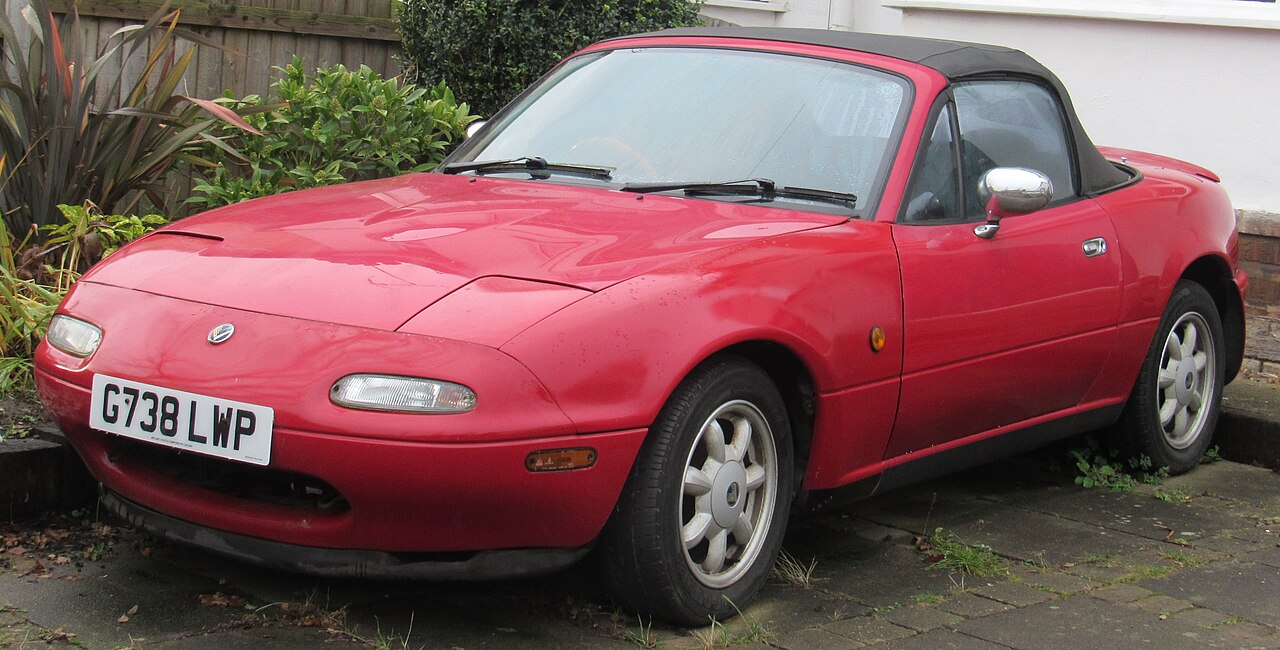
Before it was simply the “Miata” or “MX-5” worldwide, the car that revived the lightweight roadster as a viable modern category was sold in Japan through Mazda’s short-lived Eunos sales channel as the Eunos Roadster. Produced from 1989 to 1996 — after which Mazda folded the Eunos brand back into its main lineup and renamed the domestic car simply “Roadster” — the NA generation combined a simple front-engine, rear-wheel-drive layout, pop-up headlamps, and a genuinely rev-happy small engine into a formula so well-balanced it’s still the template every subsequent MX-5 has followed. This guide covers what separates the two NA engine generations, a specific early-production crankshaft detail worth knowing, and what actually needs checking on a car this simple and this popular.
📋 What You’ll Learn in This Guide
- Why “Eunos Roadster” and “Mazda Roadster” aren’t the same badge
- The real difference between the NA6CE and NA8C engines
- A specific early-production crankshaft detail worth checking
- Why the NA’s simplicity is both its biggest strength and its biggest risk from neglect
- What actually drives value on a car this common
Eunos Roadster vs. Mazda Roadster: A Badge That Changed Mid-Production
Mazda originally sold the NA generation in Japan through its dedicated Eunos retail channel, created to give the brand a more premium, specialty-focused sales presence — the Eunos Roadster was one of the channel’s flagship products. When Mazda consolidated its multiple domestic sales channels in 1996, the car was simply rebadged “Mazda Roadster” for the Japanese market going forward, with no fundamental mechanical change tied to the rename itself. For import buyers, this means an early car may carry either badge depending on exactly when it was registered, and neither name indicates a meaningfully different car — what actually matters is the engine and production year underneath.
NA6CE vs. NA8C: Two Distinct Engine Characters
The original NA6CE, built from 1989 to 1993, uses the 1.6-liter B6-ZE engine, which is genuinely eager to rev and reaches peak power high in the rev range — a character that rewards driving it hard rather than short-shifting. The NA8C, introduced for 1993, moved to the larger 1.8-liter BP-ZE engine, which trades a little of that high-rpm eagerness for noticeably more usable torque throughout the rev range, making it the more relaxed and arguably more practical choice for regular daily driving while still retaining the same fundamentally playful chassis. Neither engine is objectively “better” — the 1.6 rewards a driver willing to rev it, while the 1.8 is more forgiving day to day.
💡 Tip
Very early NA6CE production cars — generally those built in 1990 and early 1991 — used what enthusiasts refer to as a “short nose” crankshaft design, identifiable by a four-slot crank pulley, which Mazda later revised to an improved “long nose,” eight-slot design on subsequent production. This isn’t something to panic over on a well-maintained example, but it’s a genuine, documented difference in early production that’s worth asking a specialist or seller about if you’re specifically shopping the earliest NA6CE cars.
Simplicity Is the Point — And the Risk
Part of what makes the NA so beloved is how mechanically simple it is compared to more exotic JDM classics: no turbo system, no forced induction complexity, no four-wheel steering to maintain. That simplicity means routine maintenance is genuinely accessible even for a home mechanic, and parts availability remains excellent thanks to the car’s enduring global popularity. But simplicity also means there’s very little to hide behind — a neglected NA usually shows it plainly in worn suspension bushings, a tired soft top, and inconsistent compression across cylinders, rather than any single dramatic failure point. Judge the car on straightforward mechanical condition rather than assuming its reputation for reliability means neglect doesn’t matter.
Common Areas to Inspect
Check the convertible soft top for UV damage and rear window clarity (many owners have replaced the original plastic rear window with a glass unit, which is a reasonable and common upgrade rather than a red flag), inspect the frame rails and floor pans for rust consistent with the car’s age and storage history, and listen for consistent idle and clean throttle response, since the naturally aspirated engines here have little room to mask genuine wear. A compression test remains cheap insurance regardless of how clean the car looks.
⚠️ Caution
Because the NA is so common and so well-loved by the modification community, verify exactly how original the car actually is before assuming factory specification. Aftermarket suspension, wheels, and engine work are extremely common on surviving examples, and while modifications aren’t inherently a problem, they change the car’s originality and can affect both collector value and your import country’s compliance requirements.
What Drives NA Pricing Today?
Low-mileage, unmodified examples with documented maintenance history — particularly early NA6CE cars with the later-revised crankshaft or verified original units in good condition — command a premium over heavily modified cars, even though modified examples can be perfectly enjoyable to own. Rust-free bodies matter enormously given the NA’s age, and a genuinely stock, well-preserved example is becoming meaningfully harder to find than its reputation as a “common” JDM classic might suggest.
Frequently Asked Questions
Q: Is the NA6CE or NA8C the better choice for a first classic JDM import?
A: Both are excellent, low-risk choices by JDM classic standards. The NA8C’s extra torque makes it slightly more forgiving for a buyer newer to manual, high-revving small-displacement cars, while the NA6CE rewards more spirited driving — pick based on how you actually want to drive it rather than assuming one is definitively superior.
Q: Does the early crankshaft issue mean I should avoid pre-1991 cars entirely?
A: Not necessarily. It’s a documented characteristic of early production worth being aware of and asking about, not a reason to automatically rule out an otherwise well-maintained car — have any specific concerns checked by a specialist rather than avoiding the earliest cars outright.
Final Thoughts
The Eunos Roadster earned its reputation honestly: a simple, well-balanced formula that rewards careful maintenance and forgives very little neglect. It remains one of the most approachable JDM classics to actually live with day to day, provided you buy a genuinely sound example rather than the cheapest one you can find. Verify rust, compression, and originality, and the NA delivers a driving experience that explains exactly why Mazda never really needed to reinvent the formula in three decades of successors.
Image credit: 1990 Mazda Eunos Roadster 1.6, via Wikimedia Commons (CC BY-SA 4.0)
.jpg)
コメント