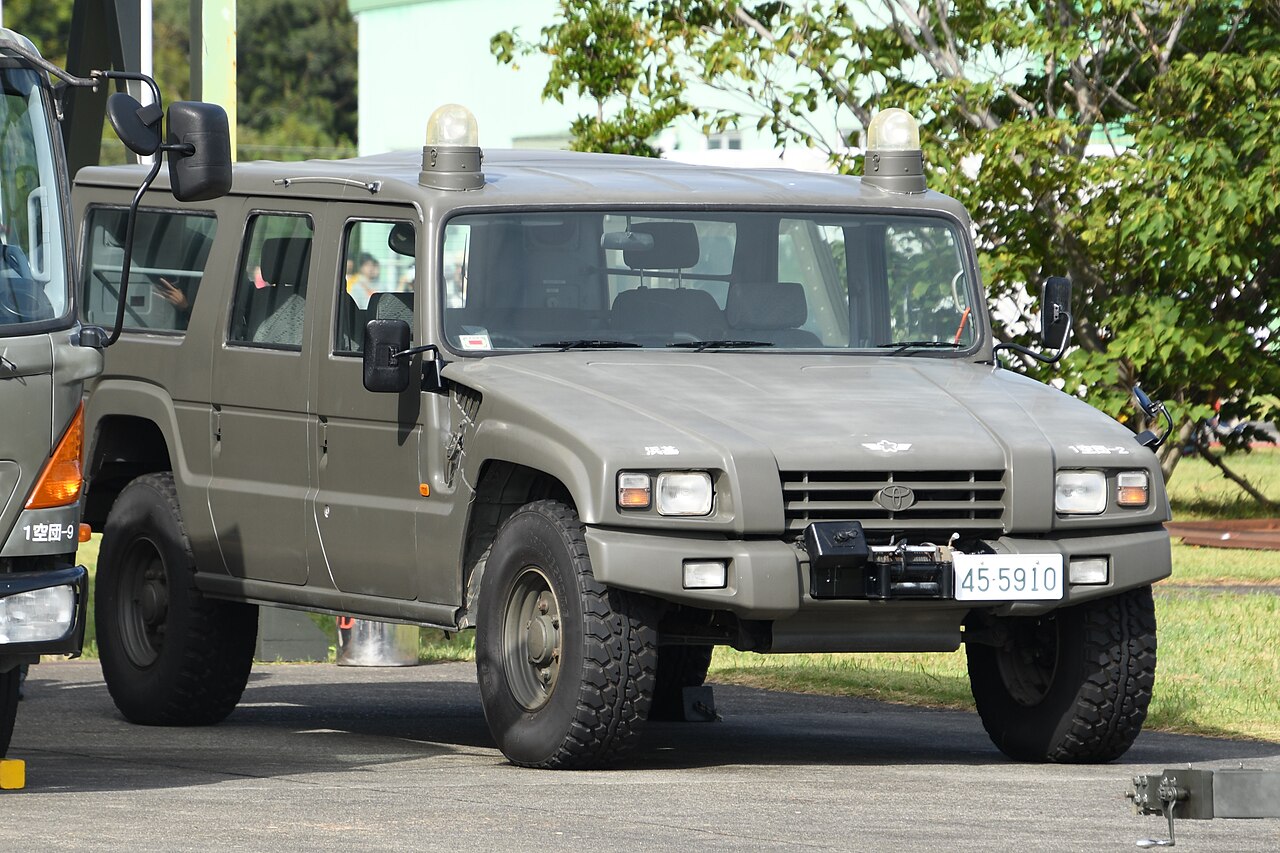
Somewhere in the vast Toyota back catalog covered throughout this guide series sits a genuinely obscure entry that dwarfs even the mighty Land Cruiser in sheer scale: the Toyota Mega Cruiser, a military-derived behemoth built specifically to rival the American Humvee, with a civilian production run so genuinely tiny it arguably makes it the rarest Toyota ever sold to the public. This guide explains this remarkable vehicle’s military origins and its extraordinarily limited civilian availability.
📋 What You’ll Learn in This Guide
- Why the Japan Self-Defense Forces needed a domestically produced Humvee rival
- The Mega Cruiser’s 1993 Tokyo Motor Show debut and 1995 production start
- The genuine difference between military (BXD10) and civilian (BXD20) variants
- Why just 133 civilian units make the Mega Cruiser arguably Toyota’s rarest car
- The Mega Cruiser’s actual military roles within the JSDF
- A Response to a Genuine Military Requirement
- From Tokyo Motor Show Prototype to Limited Production
- Military Versus Civilian Variants
- Just 133 Units: Arguably Toyota’s Rarest Car
- The Mega Cruiser’s Actual Military Roles
- Comparing the Mega Cruiser to the Hummer
- Why Toyota Never Scaled Civilian Production
- A Genuinely Different Kind of Toyota Rarity
- Frequently Asked Questions
- Final Thoughts
A Response to a Genuine Military Requirement
The Toyota Mega Cruiser’s development in the early 1990s stemmed directly from a specific Japan Self-Defense Forces requirement: a domestically produced military vehicle genuinely comparable in capability to the American Humvee, rather than relying on foreign-sourced equivalents for this specific role. This military-driven origin story shaped every subsequent aspect of the Mega Cruiser’s design and development, distinguishing it fundamentally from Toyota’s typical civilian-market-driven product development process.
From Tokyo Motor Show Prototype to Limited Production
Toyota first presented a Mega Cruiser prototype publicly at the 30th Tokyo Motor Show in October 1993, giving the broader public an early look at what would eventually become a genuinely rare production vehicle. Actual production began in late 1995 at Toyota’s Gifu Auto Body subsidiary, with sales commencing in 1996, and the vehicle’s full production run ultimately continued through 2001, totaling fewer than 3,000 examples across its entire production history — a genuinely tiny number for any Toyota nameplate, let alone one built by a manufacturer typically associated with mass-market production scale.
💡 Tip
Understanding the Mega Cruiser’s genuinely tiny total production volume — under 3,000 units across its entire six-year production run — helps contextualize just how far outside Toyota’s typical operating scale this specific vehicle sat. This wasn’t a mass-market product that underperformed sales expectations; it was always conceived and built as a genuinely low-volume, purpose-specific vehicle from the very start.
Military Versus Civilian Variants
The Mega Cruiser was produced in two genuinely distinct variant designations: the military-specification BXD10 and the civilian BXD20, with the civilian version specifically incorporating comfort-oriented features like power windows and air conditioning that the purely military-focused variant didn’t necessarily prioritize. This military-first, civilian-secondary variant structure reflects the Mega Cruiser’s genuine origin purpose clearly — the civilian version existed as essentially a comfort-adapted derivative of a fundamentally military-designed platform, rather than the reverse arrangement more typical of most civilian vehicles that occasionally see military-adapted variants developed afterward.
Just 133 Units: Arguably Toyota’s Rarest Car
Of the Mega Cruiser’s total production run, only roughly 133 units were designated for civilian sale, a genuinely staggering rarity figure that arguably makes the Mega Cruiser the rarest Toyota vehicle ever sold to ordinary civilian buyers anywhere in the world. For meaningful context, Toyota’s own iconic 2000GT — covered in an earlier guide in this series and itself a genuinely celebrated rare classic — saw a considerably larger production run of 351 units between 1967 and 1969, meaning the Mega Cruiser’s civilian availability was genuinely rarer still than one of Toyota’s most celebrated and widely coveted collector classics.
⚠️ Caution
Don’t assume a genuine civilian Mega Cruiser will be readily available or easily verified for purchase given its extraordinary rarity — with only roughly 133 civilian units ever produced, anyone encountering a purported Mega Cruiser for sale should exercise genuine due diligence to confirm authenticity and legitimate civilian registration history, since a vehicle this rare naturally attracts both genuine legitimate examples and the risk of misrepresented or fraudulent listings.
The Mega Cruiser’s Actual Military Roles
Within the Japan Self-Defense Forces, the Mega Cruiser served across a genuinely diverse range of military roles, including infantry transport duty, functioning as a light prime mover for towing heavy mortars, and supporting mobile surface-to-air missile system deployment. Most Mega Cruiser units overall, including a portion beyond the purely military JSDF role, served Japanese police, emergency response, and fire brigade applications as well, reflecting the platform’s genuine multi-role utility beyond strictly combat-oriented military duty alone.
Comparing the Mega Cruiser to the Hummer
The Mega Cruiser genuinely earned comparisons to the American Hummer H1 both in overall visual resemblance and in its underlying military-first design philosophy, standing as the largest four-wheel-drive vehicle Toyota has ever built. This scale genuinely dwarfs even the Land Cruiser, Toyota’s own long-running flagship off-road SUV nameplate covered elsewhere in broader JDM discussions — a genuinely remarkable distinction for a manufacturer whose civilian off-road lineup already includes some genuinely large and capable vehicles in its own right, further underscoring just how deliberately extreme the Mega Cruiser’s military-first design brief truly was from the outset.
Why Toyota Never Scaled Civilian Production
Toyota’s decision to keep civilian Mega Cruiser availability so genuinely minimal, rather than pursuing broader civilian market expansion for a vehicle that had already proven its underlying military capability, likely reflected a combination of factors including the vehicle’s genuinely specialized, expensive manufacturing process and its fundamentally niche appeal within Japan’s civilian vehicle market specifically. Unlike a vehicle originally designed for civilian mass-market appeal that might later see military adaptation, the Mega Cruiser’s entire engineering foundation was built around military specification requirements first, making genuine civilian mass-production scaling a considerably more complex proposition than simply expanding an already civilian-optimized product line.
A Genuinely Different Kind of Toyota Rarity
The Mega Cruiser’s rarity carries a genuinely different character than typical rare collector car scarcity driven by low original demand or a short production run for a purely civilian product — this is a vehicle whose extreme scarcity stems directly from its origin as a fundamentally military-purpose platform that only secondarily, and in genuinely tiny numbers, found its way into civilian hands at all. This distinction matters for understanding the Mega Cruiser’s specific place within broader JDM rare-vehicle culture: it represents a genuinely different category of automotive rarity than the limited-edition sports cars or discontinued niche models more commonly discussed among rare JDM enthusiasts.
Frequently Asked Questions
Q: Can a civilian Toyota Mega Cruiser be legally imported and driven outside Japan today?
A: Import eligibility for a genuine civilian Mega Cruiser depends entirely on the specific destination country’s vehicle import age, compliance, and, given the vehicle’s military-derived design, potentially additional specific regulatory requirements, so confirming current specific import regulations for a given destination is absolutely essential before pursuing any Mega Cruiser import.
Q: How does the Mega Cruiser’s price compare to more common JDM vehicles given its extreme rarity?
A: Given the Mega Cruiser’s extraordinary rarity, genuine examples typically command significantly elevated prices compared to more common JDM vehicles, though specific current market values should be researched directly rather than assumed, since extremely rare vehicles can see genuinely volatile pricing depending on individual condition and provenance.
Q: Is the Mega Cruiser related mechanically to the Toyota Land Cruiser despite the similar naming?
A: Despite the superficially similar naming convention, the Mega Cruiser represents a genuinely distinct platform developed specifically around its military requirement rather than being a direct mechanical derivative of the civilian Land Cruiser lineage, so the naming similarity shouldn’t be assumed to imply meaningful platform-sharing between the two nameplates.
Q: Did any other Japanese manufacturers develop a similar Humvee-rival military vehicle?
A: Japan’s broader military vehicle development history includes other domestically produced light military vehicles beyond the Mega Cruiser specifically, and researching Japan’s broader Self-Defense Forces vehicle procurement history would give a fuller picture of how the Mega Cruiser fit within this larger domestic military vehicle development context rather than existing in complete isolation.
Final Thoughts
The Toyota Mega Cruiser stands as a genuinely singular entry in Toyota’s vast automotive history — a military-first, Humvee-rivaling behemoth whose extraordinarily limited civilian availability of roughly 133 units makes it arguably the rarest Toyota ever to reach ordinary civilian hands. Understanding this remarkable vehicle’s military origins and genuine scarcity offers a fascinating glimpse into just how far Toyota’s actual production history extends beyond the mass-market reliability the brand is globally known for, and a reminder that even the world’s largest carmaker has occasionally built something genuinely made for a purpose far removed from the everyday commuter.
Image credit: JASDF Toyota Mega Cruiser, Hamamatsu Air Base by Hunini (CC BY-SA 4.0), via Wikimedia Commons
_right_front_view_at_Hamamatsu_Air_Base_October_20,_2019.jpg)
コメント