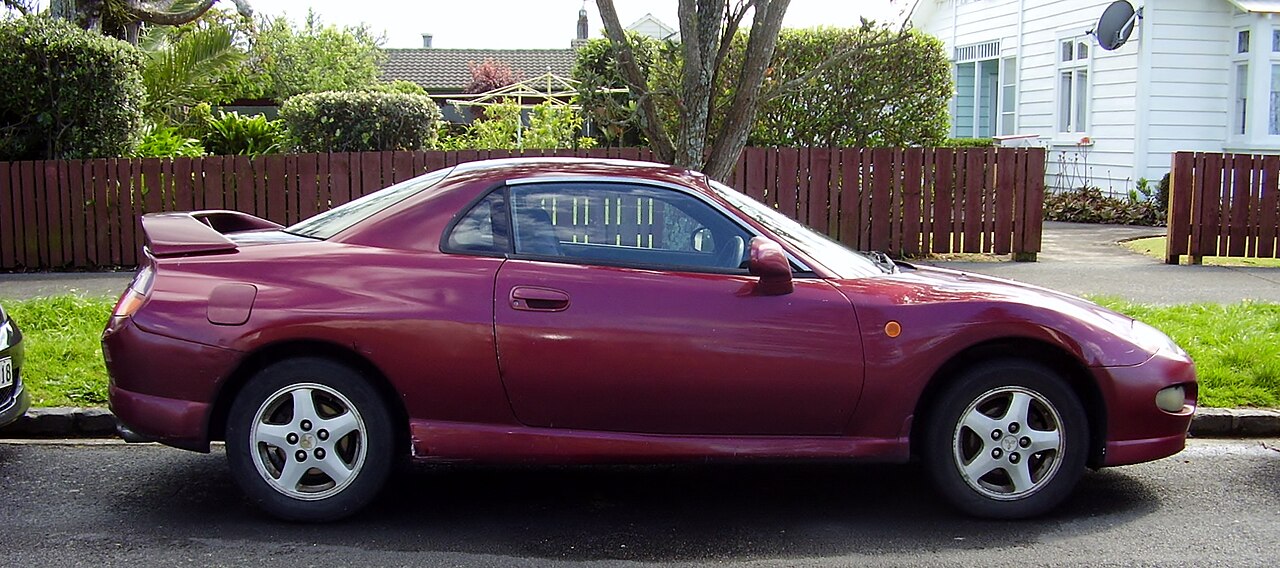
The Mitsubishi FTO never got an official export badge campaign the way the Eclipse or Lancer Evolution did, which left it as something of a hidden gem: a front-wheel-drive coupe built around the 6A12, a 60-degree, 1,998cc V6 that was among the smallest production V6 engines anywhere in the 1990s. In top GPX and GP Version R trim, Mitsubishi’s MIVEC variable valve timing and lift system pushed output to 200 PS at 7,500 rpm with a redline extending past 8,000 rpm — genuinely high-revving numbers for a naturally aspirated V6 of its era. This guide focuses on what actually determines whether an FTO is a smart buy: the timing belt interval that simply cannot be skipped, a documented early-production MIVEC issue, and the rust risk that affects this platform more than most.
📋 What You’ll Learn in This Guide
- Why the 6A12 V6’s compact size and high redline make it unusual for its era
- Why the timing belt interval is the single most important thing to verify
- A specific MIVEC solenoid issue tied to early GPX production
- The manual vs. INVECS-II automatic transmission trade-off
- Why rust matters more here than on many contemporary JDM classics
The 6A12: A Genuinely Small, High-Revving V6
At just under 2.0 liters, the 6A12 was one of the smallest production V6 engines of its decade, using a short-stroke design to keep the engine light while allowing it to rev freely. In GPX and GP Version R trim, Mitsubishi’s MIVEC system — which varies both valve lift and timing across the cam profiles rather than just timing alone — helped the engine reach 200 PS at 7,500 rpm, with the redline extending beyond 8,000 rpm. When inspecting a GPX, listen for a smooth idle with no misfires and consistent oil pressure, and confirm the MIVEC system engages cleanly around 4,500 rpm rather than hesitating or feeling flat through that transition.
The Timing Belt: Non-Negotiable on This Engine
The 6A12 is an interference engine, meaning a failed or skipped timing belt doesn’t just strand you — it results in valve-to-piston contact and effectively totals the engine. Mitsubishi’s service interval calls for the dual timing belts to be replaced roughly every 90,000 km, and this is genuinely the single biggest thing to verify before buying any FTO. A seller who can’t produce documentation of a recent timing belt service, or who’s vague about when it was last done, is presenting real financial risk regardless of how good the car looks or drives on a short test.
💡 Tip
With disciplined maintenance — consistent timing belt intervals and regular oil changes using 10W-30 API SG/SH-rated oil — the 6A12 can reasonably be expected to cover well beyond 250,000 km. This is a fundamentally durable engine when properly cared for; the risks here come almost entirely from deferred maintenance, not from any inherent design weakness.
An Early-Production MIVEC Issue Worth Knowing About
Early FTO GPX models built between 1994 and 1996 had a documented MIVEC solenoid issue that Mitsubishi resolved by the 1997 model year. If you’re specifically shopping an early GPX, ask whether the solenoid has been addressed or replaced, and be alert to symptoms like hesitation or a flat spot around the MIVEC engagement point mentioned above — this could indicate the original solenoid issue rather than a routine maintenance gap. Post-1997 examples don’t carry this specific concern.
Other Documented Issues to Check
Beyond the timing belt and early MIVEC solenoids, watch for carbon buildup on the intake valves, a common finding on higher-mileage examples that can affect idle quality and throttle response, and rear head gasket coolant leaks, which are a known issue worth checking for during any pre-purchase inspection. None of these are necessarily dealbreakers, but each is worth factoring into your assessment and your negotiating position.
⚠️ Caution
Rust is widely regarded as the FTO’s biggest overall risk factor — more so than any single mechanical issue. Inspect sills, wheel arches, and the underbody carefully, and treat visible corrosion as a more serious concern on this platform than you might on a car with a stronger reputation for rust resistance. A mechanically sound FTO with hidden structural rust is still a bad buy.
Manual vs. INVECS-II Automatic
The 5-speed manual delivers more direct driver engagement and lets you make full use of the 6A12’s high-revving character, while the INVECS-II automatic transmission adapts reasonably well to daily city driving once warmed up, though it inevitably dulls some of the engine’s eagerness. Neither choice is wrong — it depends on whether you’re prioritizing outright driving engagement or everyday usability.
Frequently Asked Questions
Q: Is the FTO a reliable car overall?
A: Yes, genuinely — most of the trouble owners encounter traces back to age and skipped maintenance rather than fundamental engineering weakness. A car with a documented timing belt interval and no visible rust is a fundamentally sound buy.
Q: Does it matter if I can’t verify the exact timing belt service date?
A: It matters enormously given the interference engine design and the catastrophic failure mode involved. If documentation genuinely isn’t available, budget for a timing belt and tensioner service immediately after purchase rather than assuming the risk away.
Final Thoughts
The FTO’s obscurity outside Japan is more a quirk of export history than any reflection of its engineering quality — the 6A12’s combination of small displacement and genuine high-rpm character remains distinctive among 1990s V6 coupes. Verify the timing belt interval above everything else, check for the early MIVEC solenoid issue on pre-1997 GPX models, and inspect for rust more carefully than you might on a more rust-resistant contemporary. Get those fundamentals right, and the FTO offers a genuinely rewarding and still relatively affordable entry point into JDM coupe ownership.
Image credit: Mitsubishi FTO, via Wikimedia Commons (CC BY 2.0)
.jpg)
コメント