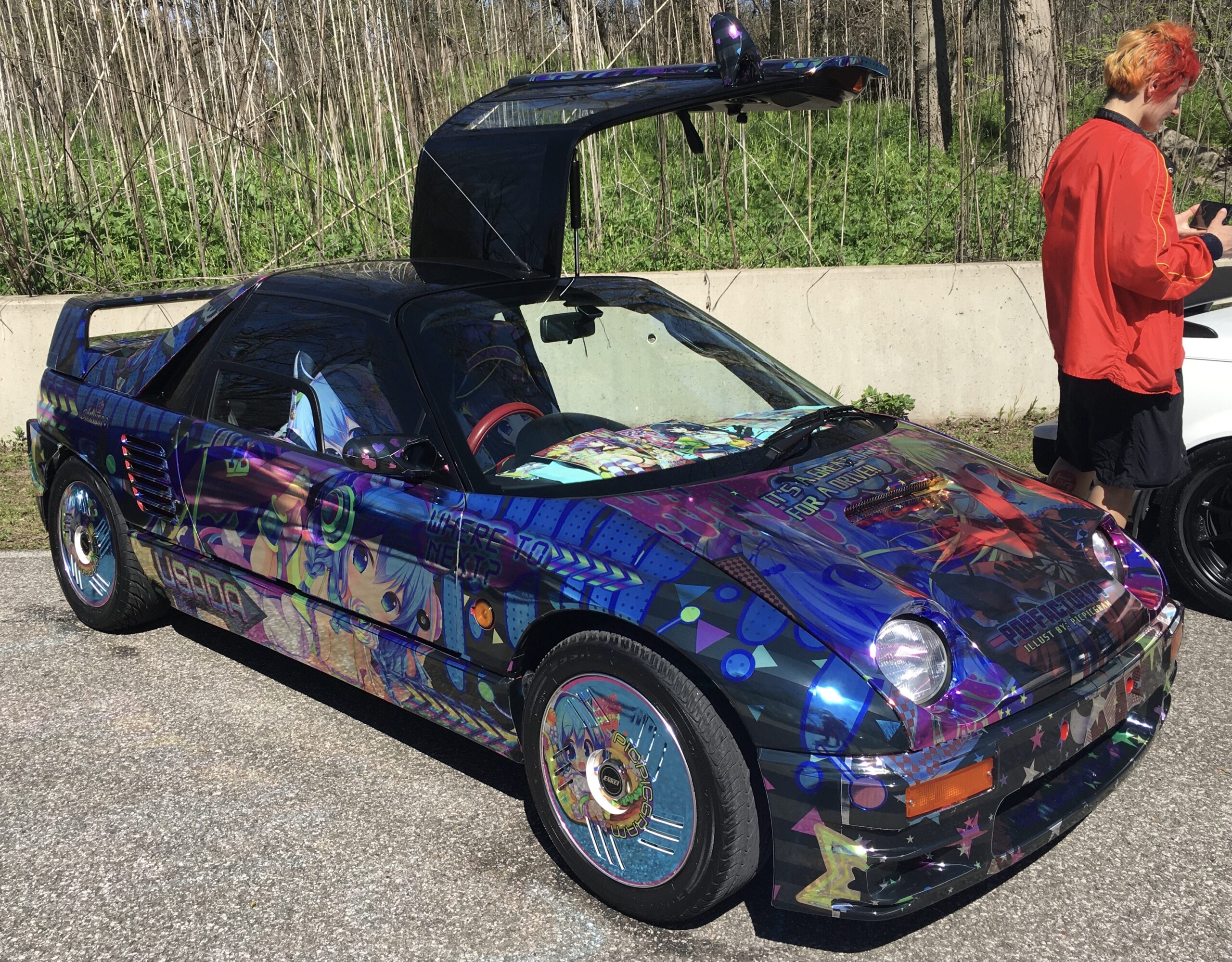
Drive through certain parking lots at Japanese anime conventions, car meets, or Tokyo’s Odaiba waterfront on the right weekend, and you’ll encounter something that looks nothing like typical car culture anywhere else in the world: vehicles wrapped floor to roofline in vivid, large-scale illustrations of anime and video game characters, often accompanied by matching interior décor, figure displays, and sound systems playing character theme songs. This is itasha — one of Japan’s most visually distinctive automotive subcultures, and one that has quietly spread into a genuine global fandom practice over the past two decades. This guide explains where the term comes from, how the movement developed, and what actually goes into building one.
📋 What You’ll Learn in This Guide
- What “itasha” actually means and where the term came from
- How the subculture grew out of Akihabara otaku culture in the early 2000s
- The difference between itasha and the related “痛単車” (itansha) and “萌え絵” styles
- What actually goes into building an itasha, from decals to full vinyl wraps
- How the culture has spread internationally through anime conventions
- What Does “Itasha” Actually Mean?
- From Window Decals to Full Vinyl Wraps
- What Actually Goes Into Building an Itasha
- Itansha: The Motorcycle Equivalent
- Why Itasha Culture Resonates Beyond Japan
- Itasha and Japan’s Broader Otaku Culture
- Itasha as a Business: Wrap Shops and Commissioned Artwork
- Maintenance and the Realities of Owning an Itasha
- Frequently Asked Questions
- Final Thoughts
What Does “Itasha” Actually Mean?
The term itasha is generally understood as a play on words rather than a single straightforward translation. It combines “itai” (痛い, meaning “painful” or, in slang usage, something closer to “cringeworthy” or “embarrassing”) with “sha” (車, “car”), while also echoing “itasha” as it would sound applied to expensive imported Italian cars — a nod to the 1980s bubble-era trend of wealthy Japanese buyers importing luxury vehicles from Italy. The pun works on two levels simultaneously: it references that older “Italian car” wordplay while redirecting the “painful” half of the meaning toward the perceived social awkwardness of covering an expensive car in illustrations of a beloved fictional character purely for the love of it, regardless of what anyone else thinks. Like many subculture names born from self-deprecating slang, “itasha” was arguably originally more of a gentle jab than a proud badge, but the community that grew up around it has long since embraced the term as a straightforward, positive self-identifier.
From Window Decals to Full Vinyl Wraps
Itasha’s roots trace to Akihabara, Tokyo’s famed electronics-and-otaku-culture district, in the early 2000s, where the earliest enthusiasts began attaching small character decals and stickers to their car windows and bumpers as a visible, low-commitment expression of fandom. As anime and gaming fandom grew more mainstream within Japan through the 2000s, and as full-vehicle vinyl wrap technology became more accessible and affordable, these modest decal jobs gradually escalated into elaborate, full-body wraps covering the entire exterior of the car in large-scale character artwork — transforming the car itself into essentially a rolling canvas rather than simply a vehicle with some stickers applied.
💡 Tip
If you want to see itasha culture at its most concentrated, Tokyo’s Odaiba waterfront district hosts periodic “Itasha Tengoku” (Itasha Heaven) gatherings that draw hundreds of decorated vehicles and their owners for informal meetups, photography, and community. Exact dates vary year to year and event details change, so check current event listings and social media rather than assuming a fixed recurring schedule.
What Actually Goes Into Building an Itasha
A serious itasha build extends well beyond the exterior wrap. Interior modifications commonly include custom seat covers and floor mats featuring the same character artwork, dashboard displays of figures and plushies related to the character, steering wheel covers, and sound systems set up to play character theme songs or voice clips from the associated anime or game. The exterior wrap itself is typically produced as a custom-printed vinyl decal set, precisely measured and cut to match the specific car’s body panels, then professionally installed by shops that specialize in this kind of large-format vehicle wrapping — a meaningfully different and more specialized skill set than either standard paint jobs or simple bumper sticker application. Costs vary enormously depending on wrap complexity, vehicle size, and whether the artwork is custom-commissioned or uses existing licensed character art, but a full professional wrap represents a genuinely significant investment, which is part of what gives the “itai” (painful, as in painful to the wallet) half of the term’s wordplay its bite.
Itansha: The Motorcycle Equivalent
Running parallel to itasha is itansha (痛単車), which applies the same basic concept — full-coverage character artwork wraps — to motorcycles rather than cars. Itansha builds face some different practical constraints than car-based itasha given a motorcycle’s smaller surface area and more complex curved bodywork, which tends to push builders toward smaller, more concentrated artwork placement (tank, fairings, tail section) rather than the sweeping full-panel illustrations possible on a car’s flat door panels and hood. The underlying motivation and community culture, though, is essentially the same fandom-driven expression seen in car-based itasha.
⚠️ Caution
Licensing matters more in itasha culture than casual observers might assume. Using officially licensed character artwork, or artwork the builder has explicit permission to reproduce, is the norm within the respected end of the community, and reputable wrap shops generally expect documentation or clear evidence of rights before producing large-scale printed character artwork. Unauthorized reproduction of copyrighted character art for a commercial wrap job raises real intellectual property concerns, and this is worth understanding before assuming any anime image can simply be printed and applied without consequence.
Why Itasha Culture Resonates Beyond Japan
Itasha’s spread outside Japan has tracked closely with the broader global growth of anime and gaming fandom over the past fifteen to twenty years. Anime conventions across North America, Europe, and elsewhere increasingly host dedicated itasha showcases and meetups as a formal part of their programming, giving international fans a venue to display builds and connect with a like-minded community in a way that simply wasn’t practical before conventions began actively courting this crowd. Online communities have also played a significant role, with builders and wrap shops in different countries sharing techniques, vendor recommendations, and design files, helping the practical craft knowledge spread well beyond Japan’s borders even as the cultural reference points (specific characters, specific franchises) remain rooted in Japanese anime and gaming media.
Itasha and Japan’s Broader Otaku Culture
It’s worth situating itasha within Japan’s broader otaku (obsessive fan) culture rather than viewing it as an isolated automotive phenomenon. The same impulse that drives dedicated fans to collect figures, attend conventions, and display fan art at home finds an unusually public, mobile outlet in itasha — the car becomes a visible, moving declaration of fandom in a way that a home figure collection simply isn’t. This public visibility is part of what makes itasha culturally distinct from other forms of fan merchandise and collecting: an itasha owner is making a deliberate choice to carry their fandom into public space, accepting whatever attention (positive or otherwise) that invites, which is a meaningfully different social statement than fandom expressed only in private spaces.
Itasha as a Business: Wrap Shops and Commissioned Artwork
Behind the hobbyist enthusiasm sits a genuine small-business ecosystem. Specialist wrap shops, concentrated in areas with strong otaku culture presence like Akihabara but also found more broadly across Japan and increasingly overseas, have built entire business lines around itasha commissions — working with clients to select or commission character artwork, producing print-ready files sized and adjusted for a specific vehicle’s exact body panel dimensions, and handling the technical installation work of applying large-format vinyl smoothly across curved surfaces without bubbling, misalignment, or premature peeling. Some shops maintain relationships with copyright holders or licensed merchandise producers to offer pre-approved character artwork, which sidesteps the licensing concerns discussed above and gives customers a straightforward, legitimate path to a build featuring their favorite character without having to navigate rights clearance themselves.
Maintenance and the Realities of Owning an Itasha
Owning a wrapped itasha comes with practical maintenance considerations that a standard painted car doesn’t have. Vinyl wraps are generally more vulnerable than factory paint to certain kinds of damage — prolonged direct sun exposure can cause fading over time, careless automated car washes with stiff brushes can lift edges or seams, and the wrap itself has a finite lifespan (commonly cited in the range of several years under good conditions) before it needs replacement or touch-up. Most dedicated itasha owners adapt their car care habits accordingly: hand washing rather than automated washes, garage or covered parking where possible, and periodic inspection of panel edges and seams where lifting is most likely to start. None of this is prohibitively difficult, but it’s a meaningfully different ownership experience than caring for a conventionally painted vehicle, and it’s worth factoring into any realistic assessment of what a serious itasha build actually involves long-term.
Frequently Asked Questions
Q: Is itasha only associated with anime, or does it cover other fandoms too?
A: While anime and manga characters are the most common subject matter historically associated with the term, the same wrapping technique and community culture has been applied to video game characters, vocaloid characters (most famously Hatsune Miku), and other Japanese pop culture properties. The core concept — full-vehicle character artwork as fan expression — extends across whatever fandom the builder is passionate about.
Q: Do itasha builds have to use vinyl wraps, or can they be painted?
A: Vinyl wrapping is by far the dominant technique because it allows precise, detailed reproduction of character artwork at a lower cost and with easier reversibility than custom paint, and it doesn’t permanently alter the car’s original finish. Airbrushed or painted character art exists but is far less common in mainstream itasha culture specifically because of the cost and permanence involved.
Q: Is there a specific type of car most associated with itasha builds?
A: There’s no single official platform, though sedans and hatchbacks with large, relatively flat body panels tend to be popular choices because they provide more usable canvas space for large character illustrations. Kei cars also appear frequently in the scene, partly reflecting their prevalence in Japan generally and partly because their compact proportions can suit smaller-scale, more concentrated designs.
Final Thoughts
Itasha culture is a genuinely unusual case of a subculture whose very name openly acknowledges the mixed reception it originally received, yet it has grown from a niche Akihabara phenomenon into a recognized, celebrated form of fan expression with a dedicated global community. Understanding the wordplay behind the name, the licensing considerations that separate respected builds from copyright-infringing ones, and the genuine craft that goes into a quality wrap gives real context to what might otherwise look, to an outside observer, like simply an unusually decorated car.
Image credit: Itasha Autozam AZ-1 by TKOIII (CC BY-SA 4.0), via Wikimedia Commons

コメント