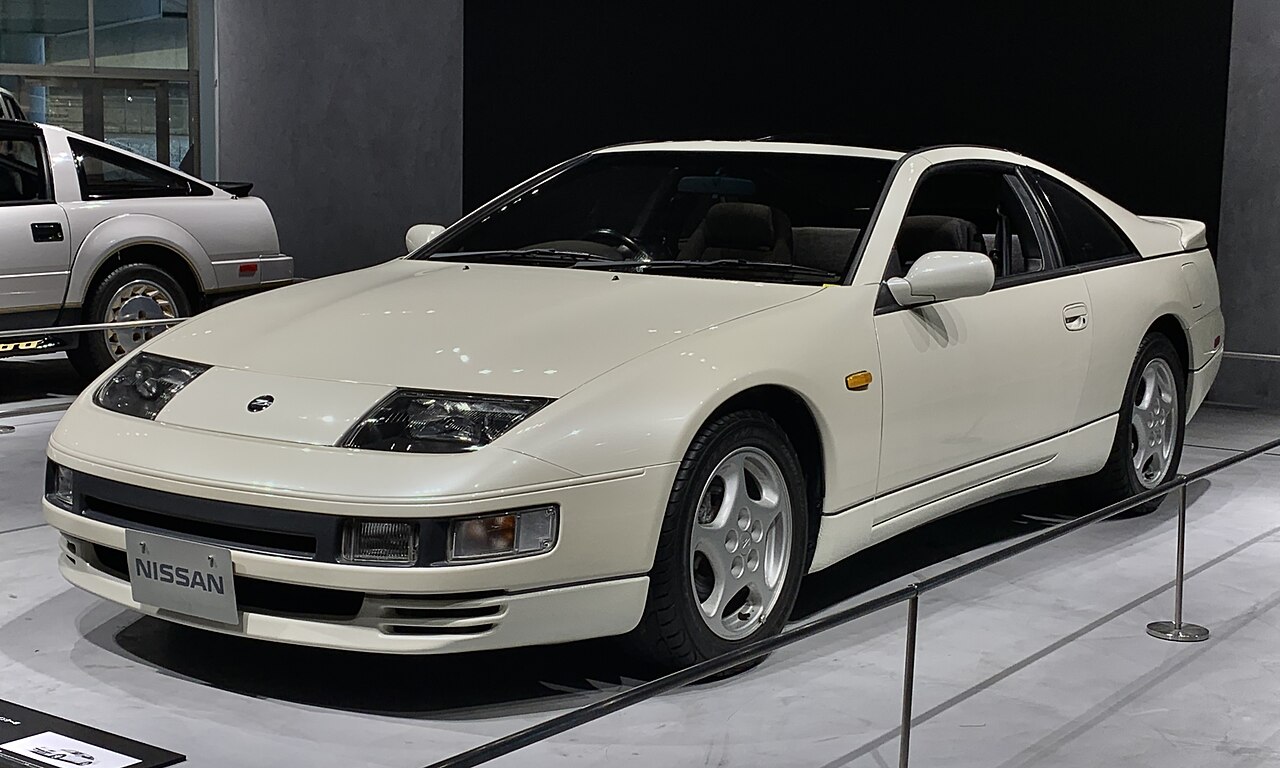
Where the AE86 built its legend on low weight and modest power, the Nissan Fairlady Z32 — sold overseas as the 300ZX — took the opposite approach: a clean-sheet, wide-body redesign built around a sequential twin-turbo V6 that felt genuinely exotic when it launched in 1989. It replaced the smaller, less powerful Z31 and stayed in production in Japan through 2000, four years longer than the US market got it. This guide explains how the JDM grade structure actually works, why the sequential turbo system is both the car’s biggest party trick and its biggest maintenance risk, and what the notorious HICAS four-wheel-steering system means for a buyer today.
📋 What You’ll Learn in This Guide
- Why “Fairlady Z” and “300ZX” aren’t quite the same car on paper
- How the sequential twin-turbo VG30DETT actually works
- What HICAS four-wheel steering adds — and what it costs to maintain
- The maintenance discipline this engine demands from a buyer
- Why Turbo and naturally aspirated versions attract very different buyers
- Fairlady Z vs. 300ZX: A More Complicated Grade Structure Than It Looks
- The VG30DETT: Sequential Twin-Turbo Engineering
- HICAS: A Genuine Handling Advantage With a Maintenance Catch
- Common Problems to Check Before Buying
- Turbo vs. Naturally Aspirated: Which Should You Choose?
- What Drives Z32 Pricing Today?
- Frequently Asked Questions
- Final Thoughts
Fairlady Z vs. 300ZX: A More Complicated Grade Structure Than It Looks
In Japan, the Z32 was sold as the Fairlady Z with a grade hierarchy far more granular than the simple base/Touring/Turbo split offered in the US market: Version S, Version R, Version N/A (naturally aspirated), Version T, and Version J trims each targeted a slightly different buyer, and several of these — Version R and Version S in particular — were never sold in the US at all. Because of Japan’s “gentleman’s agreement” horsepower cap observed across the domestic industry at the time, JDM twin-turbo cars were officially rated at 280 horsepower, even though the mechanically similar export 300ZX was rated at 300 horsepower — the two figures reflect a regulatory convention as much as any real mechanical difference. When shopping a JDM import, confirm exactly which grade you’re looking at rather than assuming “Fairlady Z” and “300ZX Turbo” are interchangeable shorthand.
The VG30DETT: Sequential Twin-Turbo Engineering
The twin-turbo Z32’s 3.0-liter VG30DETT V6 uses a sequential turbo arrangement rather than the simpler parallel setup found on many contemporaries: one turbocharger does the work at low rpm to minimize lag, and a second turbo engages above roughly 3,500 rpm to build power further up the rev range. It was sophisticated engineering for 1989, and it still delivers genuinely smooth, broad power delivery today — but that sophistication comes from a dense web of vacuum lines, actuators, and a ceramic turbo manifold, all of which have now had three-plus decades to age, crack, or fail. A twin-turbo Z32 that doesn’t pull cleanly through the full rev range, or that hesitates awkwardly around the secondary turbo’s engagement point, is very possibly telling you about a vacuum leak or a tired actuator rather than anything more serious — but it still needs a proper diagnosis before you buy.
💡 Tip
Ask for oil change records specifically, not just a general service history. The VG30DETT’s turbo bearings run on tight tolerances, and owners who stretched oil change intervals are the most common source of turbo bearing wear and eventual failure. A car with documented 3,000–5,000 mile oil changes is worth more than one with a vague “regularly serviced” claim, even if the asking price is a little higher.
HICAS: A Genuine Handling Advantage With a Maintenance Catch
Many Z32 Turbo models came equipped with HICAS (High Capacity Actively Controlled Steering), a hydraulic four-wheel-steering system designed to turn the rear wheels slightly in response to steering input and vehicle speed, improving high-speed stability and low-speed maneuverability. It’s a genuine engineering advantage over a fixed rear axle — but the hydraulic pump and its sensors degrade with age, and a failed or disabled HICAS system quietly removes one of the car’s signature handling traits without necessarily throwing an obvious warning sign. If HICAS operation matters to you, have a specialist confirm it’s functioning rather than assuming a car has it simply because it’s a Turbo trim.
Common Problems to Check Before Buying
Beyond the turbo system and HICAS, watch for rust around the wheel arches, a known weak point on Z32 bodies after decades on the road, and mismatched VIN or engine numbers on auction paperwork, which can indicate a prior engine swap or accident repair that wasn’t fully disclosed. The engine bay itself is notoriously cramped and densely packed, which makes routine maintenance more labor-intensive — and more expensive at a shop unfamiliar with the platform — than the car’s age alone would suggest.
⚠️ Caution
Because the engine bay is so tightly packed, a Z32 Twin Turbo that’s been neglected mechanically can rack up repair costs quickly once a shop actually opens things up — what looks like a single vacuum leak often turns into a full inspection of aging hoses, actuators, and wiring nearby. Budget accordingly, and treat a low asking price on a Turbo model with an unclear maintenance history as a warning sign rather than a bargain.
Turbo vs. Naturally Aspirated: Which Should You Choose?
The naturally aspirated VG30DE, without the sequential turbo system or HICAS, is mechanically simpler, cheaper to maintain, and a genuinely sound choice if you want the Z32’s styling and chassis without the turbo model’s maintenance complexity. The Twin Turbo delivers the performance the car is best known for and remains the more collectible variant, but it demands a buyer willing to stay on top of oil changes and vacuum-system upkeep. Neither choice is objectively wrong — it depends on whether you’re buying for outright performance or for a lower-maintenance ownership experience.
What Drives Z32 Pricing Today?
Twin Turbo models with documented maintenance history, rust-free bodies, and functioning HICAS command the strongest prices, followed by clean naturally aspirated examples. JDM-only grades like Version R and Version S carry additional desirability among enthusiasts specifically because they were never officially available in export markets. As with any JDM import, build a full landed-cost estimate — vehicle price, agent fees, shipping, insurance, and your home country’s duties and compliance costs — before settling on a budget.
Frequently Asked Questions
Q: Is the Z32 Turbo reliable if properly maintained?
A: The VG30DETT is a fundamentally sound engine, but its reliability is closely tied to maintenance discipline — specifically oil change frequency and periodic inspection of the turbo system’s vacuum lines and actuators. A well-documented example is a very different ownership proposition from a neglected one.
Q: What’s the real-world difference between JDM “Version R” and the export 300ZX Turbo?
A: They share the same fundamental VG30DETT platform, but JDM Version R and Version S grades included trim, suspension, and equipment configurations specific to the Japanese market and were never sold under the 300ZX badge overseas, which is part of why they carry a desirability premium with import buyers today.
Final Thoughts
The Z32 remains one of the most technically ambitious Japanese sports cars of its era, and that ambition is exactly why it rewards a careful buyer and punishes a careless one. Confirm the maintenance history behind any Twin Turbo example, have HICAS function verified rather than assumed, and budget for the fact that this engine bay does not forgive shortcuts. Buy right, and the Z32 still delivers a genuinely modern-feeling driving experience for a car designed well over three decades ago.
コメント